Why OI Trends Matter More Than Single-Day Snapshots
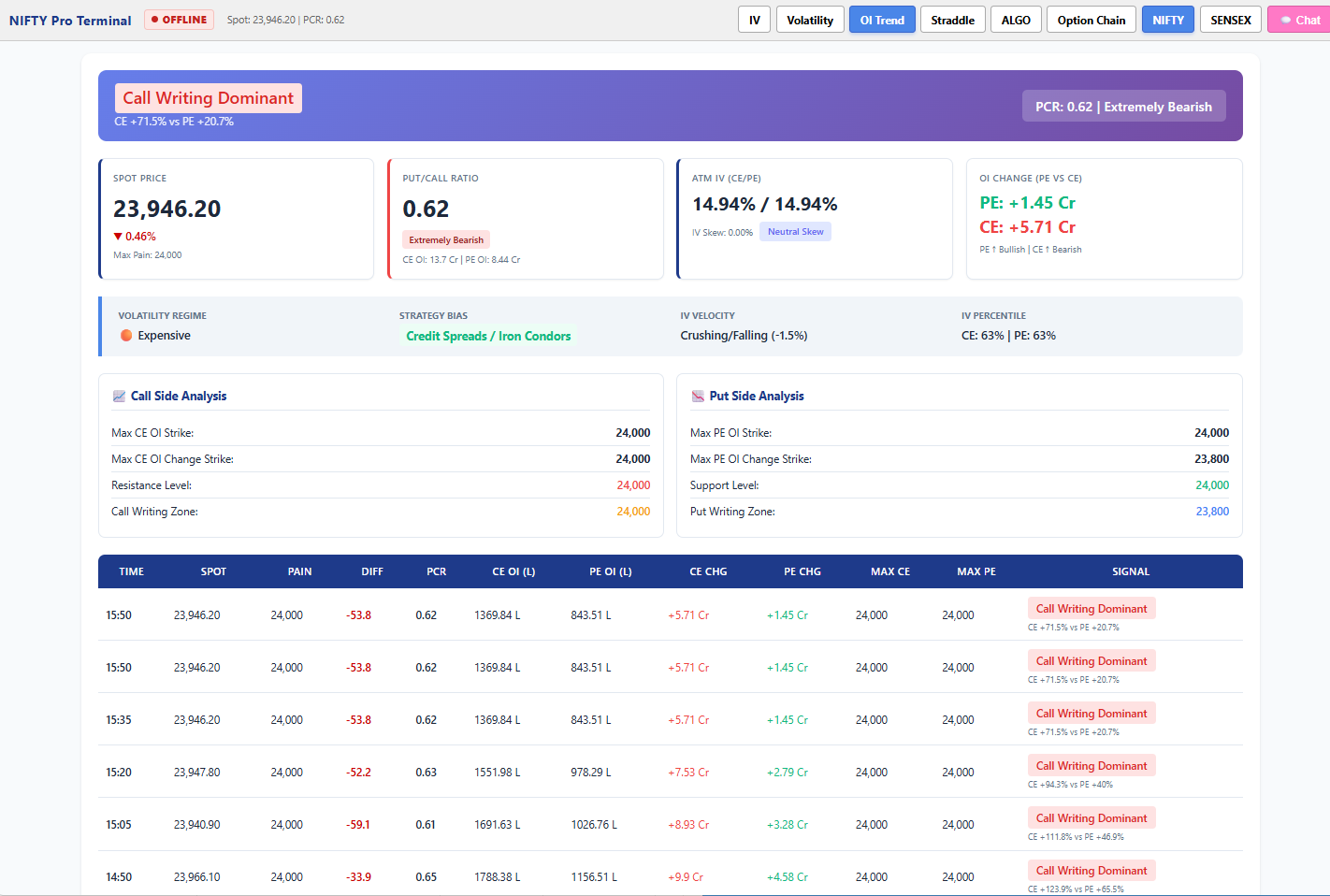
Heres something most beginners get wrong – they look at today's option chain, see some big OI numbers at certain strikes, and make trading decisions based on that single snapshot. But heres the problem: you're missing the story.
Open interest tells you where positions exist, but OI trends tell you how those positions are evolving. And that evolution? Thats where the real insights hide. Is that huge put OI at 19500 building up over last 3 days (bullish signal – writers confident) or is it unwinding from even higher levels (could be bearish – positions closing)? Same current OI number, completely different implications depending on the trend.
This is exactly why we built dedicated OI trend tracking on FNOChain. Not just showing you numbers, but visualizing the journey those numbers took to get where they are now. And giving you tools to spot when that journey is about to take an interesting turn.
Core Features of Our OI Tracker
Historical OI Charts
Visualize OI movement over days, weeks, or months for any strike. See the full picture instead of guessing from isolated data points.
OI Change Heatmap
Color-coded matrix showing where OI is building up (green) or unwinding (red) across all strikes. Instant pattern recognition.
Build-Up Detection
Algorithm identifies sustained OI accumulation at specific strikes over multiple sessions. Early warning system for potential support/resistance formation.
Unwind Alerts
Get notified when significant OI positions start closing out. Often precedes directional moves as hedgers remove protection or speculators exit.
Smart Money Indicator
Track OI patterns typically associated with institutional activity – large block builds, coordinated strike movements, unusual expiry rollovers.
Multi-Expiry Comparison
Compare OI trends across weekly, monthly, and quarterly expiries simultaneously. Spot rollover patterns and calendar spread activity.
Understanding OI Build-Up Patterns
Not all OI creation is equal. The context around how and why OI is building up matters enormously for interpretation. Let me break down the common scenarios you'll encounter:
You notice 19500 PE OI has grown from 2 lakh to 8 lakh contracts over past 5 trading sessions. Price has been consolidating in 19600-19800 range. This pattern suggests market participants are confidently selling puts – they dont expect price to break below 19500 anytime soon. Often seen before upside breakouts or during accumulation phases.
20000 CE OI steadily climbing while price struggles near 19900. Each attempt to push higher gets sold into with fresh call writing. Classic resistance formation. Smart money capping upside, possibly expecting correction or range-bound behavior.
Huge PE OI built up during recent fall starts rapidly declining even though price isnt dropping further. Short covering happening – bears exiting, bulls might be taking control. These unwind phases often lead to sharp short-covering rallies.
The beauty of our trend tracker is you dont have to manually compare yesterday's chain with today's and try to remember what happened last week. Its all visualized automatically. You can literally see the story unfolding in front of you.
How to Use OI Heatmaps Effectively
Our OI heatmap feature is probably the one traders fall in love with first because its so intuitive. Heres how to read it properly:
The heatmap shows all strikes in a grid format with colors representing OI change intensity. Dark green means heavy OI addition (build-up), light green moderate addition, yellow minimal change, light red moderate reduction, dark red heavy unwinding.
- Look for color clusters: If you see a band of green around 19400-19600 puts and another cluster of red at 19800-20000 calls, thats telling you a clear range story forming
- Watch for color shifts mid-day: Sometimes morning heatmap looks different from afternoon. Intraday changes often reveal intraday sentiment shifts before price confirms them
- Compare across expiries: Weekly expiry heatmap might show different patterns than monthly. Near-term expiry reacts faster to news, farther expiries show structural positioning
- Note asymmetry: When one side (calls or puts) shows much more intense color than other, market is leaning directionally. Balanced colors suggest range-bound expectations
Detecting Smart Money Through OI Trends
"Smart money" gets thrown around a lot in trading circles, sometimes meaninglessly. But when it comes to OI analysis, there are genuinely identifiable patterns that tend to correlate with institutional or informed trader activity:
Pattern 1: Coordinated Multi-Strike Movement
Retail traders usually pick one or two strikes. Institutions often build positions across multiple adjacent strikes simultaneously – like adding OI to 19400, 19500, AND 19600 PEs in same session. Our tracker flags this coordinated behavior.
Pattern 2: Size Anomalies
Suddenly a strike adds 10x its average daily OI change. Could be a large hedge fund entering or major corporate hedging activity. Either way, worth investigating why someone is deploying that much capital there.
Pattern 3: Expiry Rollover Timing
Smart money often rolls positions 2-3 days before retail crowd realizes expiry is approaching. Watching OI decline in near expiry的同时 seeing corresponding rise in next expiry gives you early heads-up on institutional repositioning.
Pattern 4: Contrarian Build-Up
When everyone is bullish (high PCR, call OI dominating) but you notice steady put OI building at lower strikes despite no price weakness – thats often sophisticated players buying cheap insurance or positioning for reversal they see coming.
Practical Trading Applications
Alright enough theory, lets talk about how this translates to actual trades you can take:
- Range Trading with OI Boundaries: Identify strong put support level (heavy OI buildup, stable/increasing) and call resistance level (similar characteristics). Sell straddles or iron condors between these zones. Adjust if OI trends show boundaries breaking down.
- Breakout Confirmation: Price approaching resistance but you notice call OI at that strike starting to unwind while put OI below is stable. Resistance might be weakening – prepare for potential breakout long entry.
- Trend Continuation Signals: In an uptrend, if you see consistent call OI buildup at progressively higher strikes (today 19800 CE building, tomorrow 19900 CE, etc.) while puts at lower strikes remain stable – trend likely intact. Ride it until OI pattern reverses.
- Reversal Warnings: Existing trend in place but suddenly OI starts building aggressively on opposite side. For example, uptrend running but massive put OI starts accumulating at key support. Could be smart distribution happening before reversal.
- Event Play Positioning: Before budget/RBI/events, watch which strikes see pre-event OI buildup. Post-event, track how quickly that OI unwinds. Fast unwind = event was priced in and outcome within expectations. Slow/sticky OI = surprise element, more volatility likely.
Advanced Settings & Customization
Every trader analyzes OI differently, so we've made our tracker highly customizable:
- Timeframe Selection: View OI trends over 1-day, 1-week, 1-month, or custom date ranges depending on your trading horizon
- Sensitivity Adjustment: Control what constitutes "significant" OI change for alerts. Aggressive settings for scalpers, conservative for swing traders
- Strike Filtering: Focus on ATM/ITM strikes only, OTM only, or specific ranges you care about. Reduce noise from far OTM options that rarely matter
- Comparison Mode: Overlay multiple underlyings' OI trends to spot correlation – useful when trading index vs stock options or related sectors
- Export Capabilities: Download OI trend data for your own backtesting or algorithmic strategies. CSV and JSON formats available
Common Pitfalls to Avoid
After years of using OI trend analysis, Ive learned these lessons the hard way so you dont have to:
- Dont ignore expiry dynamics: OI behaves very differently in expiry week due to gamma effects, pinning, and rollover activity. A pattern that works in mid-month might fail spectacularly near expiry.
- Absolute OI vs Percentage Change: Adding 50,000 contracts to a strike with existing 10 lakh OI (5% increase) is different from adding 50,000 to a strike with 1 lakh OI (50% increase). We show both metrics because each tells part of the story.
- Volume Confirmation: Big OI change with tiny volume = possibly just rollover or internal adjustments. Big OI change WITH high volume = genuine new position creation. Always check both.
- Context Matters Immensely: Is OI building because people are bullish, or because they're forced to hedge? Is unwinding happening due to profit booking or stop-loss triggers? Same OI number, opposite implications depending on narrative.
- Dont Over-Optimize: Some traders create incredibly complex OI-based systems with 15 indicators. Keep it simple. 2-3 reliable signals beat 15 noisy ones every time.
Getting Started with OI Trend Analysis
If you're new to reading OI trends, here's my suggested learning path:
Week 1: Just observe. Pick Nifty weekly expiry, check our OI heatmap every day. Dont trade based on it yet. Just note patterns you see and verify later whether price behaved as OI suggested or not.
Week 2: Start paper trading. Based on OI trends you're observing, make hypothetical trades and track results. See if your OI readings are translating to accurate predictions.
Week 3: Small position sizes. Begin taking actual trades using OI trend confirmation alongside your existing strategy. Risk minimal capital while you validate the approach.
Week 4 onwards: Gradually increase involvement as confidence builds. Add more advanced features like smart money detection and multi-expiry comparisons to your toolkit.
Remember, OI trend analysis is a skill not a shortcut. It takes time to develop intuition for reading these patterns correctly. But once you do, you'll have an edge that most retail traders simply dont possess because they're still stuck looking at single-day snapshots.
Our platform gives you the data visualization and analytical tools. The expertise comes from putting in screen time and learning from both wins and losses. Start your OI trend journey today on FNOChain – the data is waiting to tell its story to whoever's willing to listen carefully enough.