Master Options Strategies with Powerful Analysis Tools
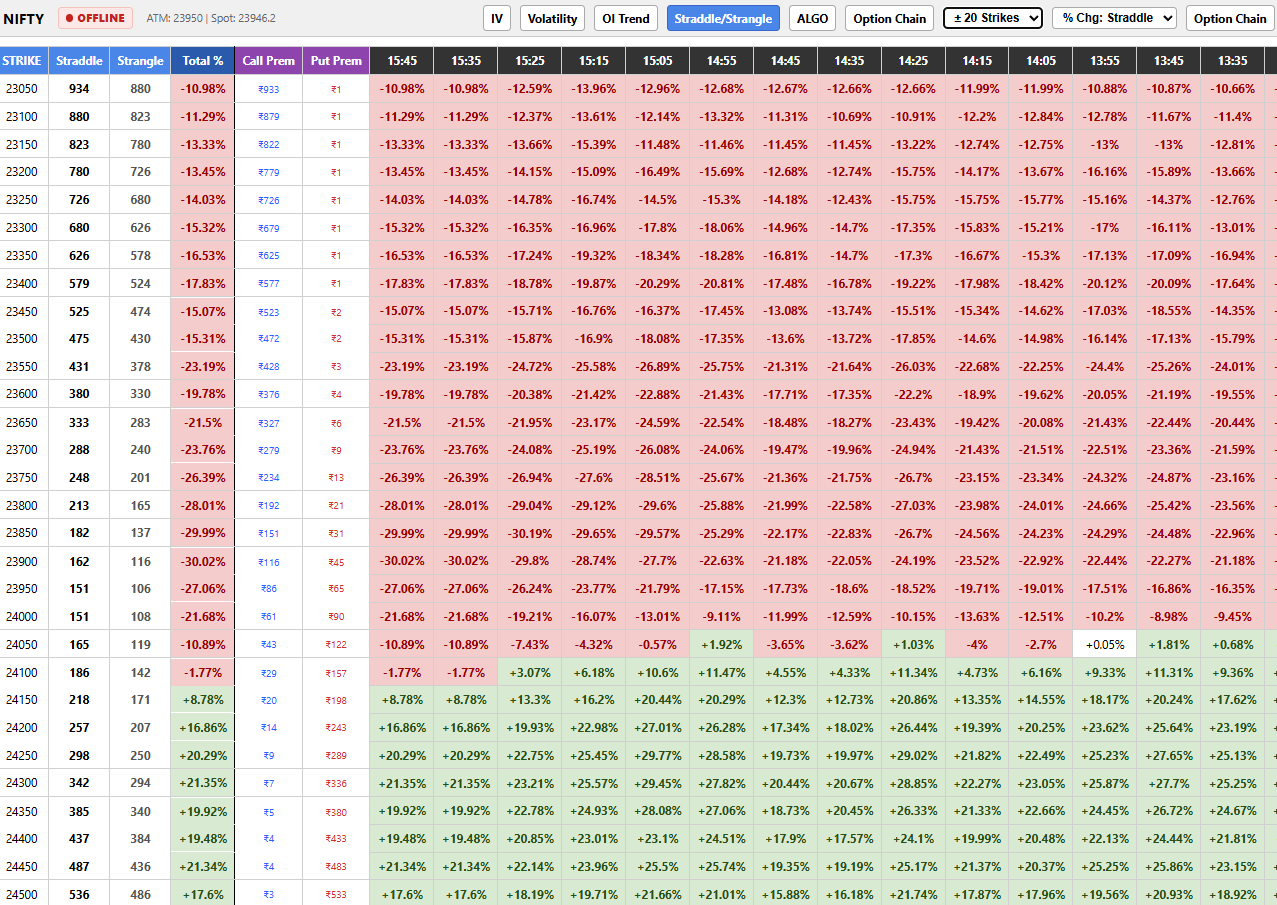
If you've been trading options for any length of time, you know that buying naked calls or puts is rarely the optimal approach. Sure it works sometimes, but the professionals? They're using structured strategies that give them defined risk-reward profiles and statistical edges. Thats exactly what our strategy builder helps you achieve.
Whether you're looking to trade volatility with straddles and strangles, generate income through premium selling, or construct complex multi-leg positions like iron condors and butterflies – we've got you covered with tools that make strategy construction intuitive rather than intimidating.
Core Strategies Available on FNOChain
Long Straddle
Buy ATM call + ATM put. Profits from big moves in either direction. Best when you expect significant volatility but unsure of direction – earnings, budget, major events.
Short Straddle
Sell ATM call + ATM put. Profit if market stays rangebound. Collect premium but face unlimited risk. Advanced strategy requiring strict risk management.
Long Strangle
Buy OTM call + OTM put. Cheaper than straddle but needs bigger move to profit. Good when you expect explosive movement but want lower cost entry.
Short Strangle
Sell OTM call + OTM put. Wider profitable range than short straddle. Popular income strategy when IV is high and you expect mean reversion.
Iron Condor
Combine bull put spread + bear call spread. Defined risk, defined reward. Profit from time decay in rangebound markets. Favorite of professional premium sellers.
Butterfly Spread
Combination of bull and bear spreads converging at central strike. Maximum profit at specific target price. Low cost, defined risk, precise directional bet.
Deep Dive: Long Straddle Strategy
The long straddle is probably the purest play on volatility itself rather than direction. You're essentially saying "I dont know which way its going, but I know its going somewhere big." Let me break down exactly how it works:
Construction:
- Buy 1 ATM Call option
- Buy 1 ATM Put option (same strike, same expiry)
- Total debit paid = your maximum risk
When It Works Best:
Scenario A: RBI surprises hawkish, Nifty drops to 19200
- Put value ≈ ₹400, Call value ≈ ₹5
- Net profit = ₹248 per lot (400+5-157)
Scenario B: RBI dovish surprise, Nifty rallies to 20000
- Call value ≈ ₹380, Put value ≈ ₹3
- Net profit = ₹226 per lot (380+3-157)
Scenario C: Policy as expected, Nifty stays at 19650
- Call value ≈ ₹65, Put value ≈ ₹22
- Net loss = ₹70 per lot (65+22-157)
Breakeven Points:
Upper breakeven = Strike + Total Premium Paid
Lower breakeven = Strike - Total Premium Paid
In our example: Upper BE = 19600 + 157 = 19757, Lower BE = 19600 - 157 = 19443. Market needs to move beyond these levels by expiry for profit.
Critical Success Factors:
- Entry Timing: Buy straddles BEFORE IV expansion, not after. Once news is out and IV already spiked, you're paying inflated prices. The ideal entry is when IV is relatively low but expected to rise due to upcoming event.
- Exit Discipline: Dont hold through entire IV crush post-event. Most straddle profits come in quick bursts during/after event. If market moves 200 points in your favor within hours, consider taking profits rather than holding to expiry hoping for more.
- Position Sizing: Straddles are expensive because you're buying two options. Keep position size small enough that max loss wont hurt badly. Many traders risk only 1-2% capital on straddle trades.
Deep Dive: Short Strangle for Income Generation
While long straddles bet on movement, short strangles bet on lack thereof. This is one of the most popular strategies among experienced traders who prefer selling premium and letting time decay work in their favor.
Construction:
- Sell 1 OTM Call (typically 1-2 strikes above spot)
- Sell 1 OTM Put (typically 1-2 strikes below spot)
- Both same expiry, usually near-term for faster theta decay
- Credit received = maximum profit (if market stays between strikes)
Why Traders Love Short Strangles:
| Advantage | Explanation |
|---|---|
| High Probability of Profit | Market stays rangebound 70-80% of time statistically. Short strangles profit in this scenario. |
| Time Decay Friend | Theta (time decay) works FOR you. Every day that passes without big move = money in pocket. |
| IV Mean Reversion | When IV is elevated, you collect rich premiums. As IV normalizes, options lose value rapidly. |
| Wider Range Than Straddle | OTM strikes give more room for error compared to ATM short straddle. |
Ideal Conditions for Short Strangles:
- High IV Environment: India VIX above 18-20 makes premiums attractive. You're selling expensive options which gives better risk-reward.
- Rangebound Market: Price consolidating in clear channel. No strong trend visible. Support and resistance levels holding well.
- No Major Events: Avoid selling strangles right before budget, elections, Fed meetings, etc. Event risk can cause sudden large moves against you.
- Near Expiry: Selling in weekly expiries (especially Thursday/Friday entries for weekly expiry) maximizes theta decay benefit.
- Liquid Underlying: Only sell strangles in highly liquid indices (Nifty/BankNifty) or stocks. Illiquid options can gap wildly on you.
Advanced: Iron Condor – Defined Risk Premium Selling
For traders who like the idea of short strangles but cant stomach unlimited risk, iron condor is the answer. Its basically a short strangle with insurance built in.
Construction:
- Bull Put Spread: Sell OTM Put + Buy further OTM Put (lower strike)
- Bear Call Spread: Sell OTM Call + Buy further OTM Call (higher strike)
- All four legs same expiry, typically 0DTE to weekly
- Net credit received = maximum profit
- Maximum loss = Width of wider spread - Net credit (CAPPED!)
Iron Condor vs Short Strangle Comparison
| Factor | Short Strangle | Iron Condor |
|---|---|---|
| Max Profit | Higher (no cost for protection) | Lower (pay for wings) |
| Max Loss | Unlimited/Substantial | Defined & Limited |
| Margin Required | Very High (naked sells) | Lower (spread margins) |
| Peace of Mind | Stressful during moves | Know worst case upfront |
| Best For | Experienced pros with discipline | Most traders, especially beginners |
Our Strategy Builder Features
On FNOChain, we don't just explain strategies – we give you interactive tools to build and analyze them in real-time:
- Visual Payoff Diagrams: See your P&L curve at expiry AND before expiry. Understand how time decay affects your position day by day.
- Greeks Analysis: View Delta, Gamma, Theta, Vega exposure of combined position. Know exactly how sensitive your strategy is to various factors.
- Breakeven Calculations: Automatically computed and displayed. No manual math needed.
- Probability Metrics: Statistical probability of profit based on current IV and historical volatility. Data-driven decision making.
- "What-If" Scenarios: Adjust underlying price, IV, time to see how your position would perform under different conditions.
- Multi-Leg Support: Build complex strategies with 6+ legs if needed. System handles all calculations seamlessly.
- Real-Time Updates: During market hours, see live P&L as prices move. No need to manually recalculate anything.
- Strategy Templates: Pre-built templates for common strategies. Click once, adjust parameters, done.
- Export & Sharing: Save your strategies, export analysis reports, share with trading community for feedback.
Choosing the Right Strategy for Market Conditions
Different market conditions demand different approaches. Heres my framework for strategy selection:
Scenario 1: Pre-Event (Earnings, Budget, Policy)
→ IV usually rising → Consider Long Straddle/Strangle if entering early enough
→ If IV already spiked → Maybe avoid or look at Calendar Spreads instead
Scenario 2: Post-Event IV Crush
→ IV collapsing rapidly → Perfect for Short Strangles/Iron Condors
→ Capture premium as IV deflates back to normal levels
Scenario 3: Strong Trending Market
→ Clear direction with momentum → Directional spreads (Bull Call/Bear Put)
→ Or simple long calls/puts if conviction is very high
Scenario 4: Choppy Sideways Market
→ No clear direction, rangebound → Iron Condors/Short Strangles shine here
→ Time decay working in your favor while market goes nowhere
Scenario 5: Extreme VIX (>30)
→ Fear is high, premiums expensive → Sell premium strategies become attractive
→ But keep position sizes smaller – volatility can stay extreme longer than expected
Risk Management Principles for Options Strategies
No matter which strategy you choose, proper risk management is non-negotiable. Here are rules I follow religiously:
- Never Risk More Than 2% Per Trade: On any single options position, maximum loss shouldnt exceed 2% of total trading capital. For undefined risk strategies (naked sells), calculate worst-case scenario and size accordingly.
- Define Exit Rules BEFORE Entry: Know your stop-loss level, target profit level, and time stop (if position isnt working by X days, exit regardless). Write it down.
- Respect Correlation Risk: If you have 5 different short strangle positions all in banking stocks, you're not diversified – you're concentrated in one sector. Be aware of hidden correlations.
- Adjust, Don't Just Hope: When trade goes against you, have predefined adjustment protocols. Rolling strikes, adding protection legs, reducing size – know what you'll do before emotions take over.
- Track Your Statistics: Maintain detailed log of every trade – entry reason, exit reason, P&L, lessons learned. Review monthly to identify patterns in your performance.
Getting Started with Strategy Building
New to multi-leg options strategies? Here's my recommended progression path:
Phase 1 (Weeks 1-2): Paper trade only. Use our builder to construct strategies, watch how they behave in real-time markets, understand greeks movements. Zero capital at risk while learning mechanics.
Phase 2 (Weeks 3-4): Small real positions. Start with iron condors on Nifty/BankNifty (defined risk). Use minimal lots. Focus on execution and adjustment process, not profits.
Phase 3 (Month 2): Expand repertoire. Add short strangles (with strict stops), long straddles around events, basic vertical spreads. Still keeping position sizes modest.
Phase 3+ (Ongoing): Develop personal style. Some traders specialize in premium selling, others focus on volatility plays, some mix both. Find what suits your personality and risk tolerance.
Options strategies are incredibly versatile – thats what makes them beautiful and dangerous at the same time. With great power comes great responsibility (cliché but true here). Our strategy builder gives you the analytical edge. Discipline and experience provide the rest.
Start exploring different strategies on FNOChain today. Build them, visualize them, understand them deeply before risking real money. The traders who survive long-term in options game arent necessarily the smartest ones – they're the most prepared and disciplined ones. Be one of them.